RQMO iRARE Centre

There is now an iRARE Centre for Canadians outside of Quebec. Visit the website.
For French-speaking Canadians outside Quebec, please contact us at info@irarecentres.org.
Knowledge sharing is the very essence of the iRARE RQMO Centre. We have set ourselves the goal of being at the cutting edge of developments in the field of rare diseases and of making them accessible and understandable.
We offer a variety of services adapted to your needs, whether you are an individual suffering from a rare disease, a caregiver, an association, a health professional or any other person with a question regarding a rare disease.
The information is transmitted free of charge by bilingual professionals trained for this purpose.
Please note that we do not provide medical advice and we suggest that you discuss the information received with your healthcare team.
Information on a rare disease
Have you, your child or a loved one just been diagnosed with a rare disease and want to know all about it? We can put together a disease fact sheet for you.
- A short description of the disease
- Review articles and practice guidelines for medical management
- Patient associations
- A list of experts or clinics specializing in the disease
- Expert researchers and their research projects
- Ongoing clinical trials
- Orphan drugs in development and on the market.
Or if you have a specific question about the disease, we can research the answer for you.
The information collected comes from reliable, official and up-to-date sources.
Note: we respect the same confidentiality rules as in our health system.
EHLERS-DANLOS SYNDROME
Many people contact us because they suspect they have Ehlers-Danlos syndrome. Si vous habitez à l’extérieur du Québec, contactez le EDS Canada Foundation. For residents of Quebec, see our Ehlers-Danlos syndrome webpage.
Find out for yourself
Orphanet
The portal for rare diseases and orphan drugs. For the general public and professionals. More than 6,000 rare diseases listed. Information in 9 languages, including French. Resources in over 40 countries (Canada has participated in the past; there is some information in the portal).
For each disease, you will be able to find these resources : (notez que les ressources des États-Unis ne sont pas incluses; voir ci-dessous ressources américaines)
- Expert centres
- Associations
- Orphan drugs
- Research projects
- Clinical tests
- Registries/databases/research networks
- Diagnostic tests
And the following documents:
- Signs and symptoms
- Articles for general public (in French)
- Recommendations for clinical practice
- Emergency procedures
- Disability: information on activity limitations/participation restriction
- Recommendations for anesthesia
- Information about a drug
Start here www.orpha.net or consult Orphanet’s List of rare diseases
You can also download the Orphanet application application in six languages (iPhone or iPad) and Orphanet Guides.
Other sources of information
- Genetic and Rare Diseases Information Center (GARD)
- Disease Infosearch
- Rare Disease Database (National Organization for Rare Disorders)
- Merck Consumer Manuals
- 23 networks – Filières de Santé Maladies Rares (filieresmaladiesrares.fr)
- StatPearls – NCBI Bookshelf (nih.gov)
Genetic Disease, Gene, and Genetic Testing Databases
- Medline Plus – Genetic conditions
- GeneReviews
- Genes and Disease (National Center for Biotechnology Information)
- OMIM
- Genetic Testing Registry
- Gene database
Experts and expert centres
Clinical tests
- Public clinical trials registry – Clinical Research Quebec (recherchecliniquequebec.com)
- Search for a clinical trial in Canada
- Clinical trials worldwide (including Canada): ClinicalTrials.gov
- Clinical Trials in the European Union – EMA (euclinicaltrials.eu)
- Orphanet: search for a clinical trial
- International Clinical Trials Registry Platform
Patient registries
- Orphanet registries/biobanks
- ClinicalTrials.gov (research registries are listed on this site)
- Registries where patients can register themselves: see our Directory of rare disease registries
Databases of books and scientific articles
- Pubmed Central (open access scientific articles)
- PubMed (more complete, but the articles are not all open access)
- Bookshelf
- Orphanet Journal of Rare Diseases
- Journal of Rare Diseases
- Journal Rare Disorders: Diagnosis & Therapy
- Rare
- International Journal of Rare Diseases and Disorders
Information on drugs for rare diseases
See our web page: « Drugs – Resources »
Pharmaceutical industry
Organizations in the field of rare and orphan diseases
- Canadian Organization for Rare Disorders (CORD)
- B.C. Rare Disease Foundation
- Orphanet (Europe)
- EURORDIS (Europe)
- Alliance Maladies Rares (France)
- Rare diseases info services
- National Organization for Rare Disorders (NORD) (United States)
- Genetic Alliance (United States)
- Global Genes (United States)
- Genetic Alliance (United Kingdom)
- Rare Diseases International
You did not find what you were looking for....
If you haven't found the information you're looking for, we can help you. Our professionals are trained to find all the information on a rare disease and have access to specialized websites. Contact our iRARE Center. We are here to serve you!
No diagnosis
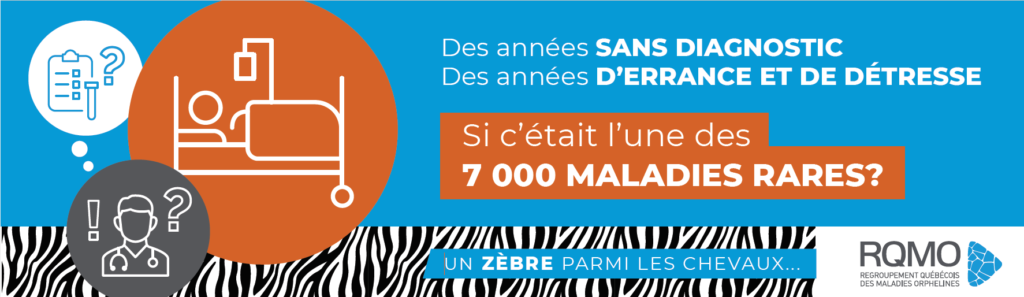
YOU DON’T HAVE A DIAGNOSIS?
Even if your (or your child’s) disease doesn’t have a name or the diagnosis isn’t yet certain, contact our iRARE Center.
We can explore with you if there are some possible avenues that can be taken to obtain a diagnosis in the health network or through research. It is also possible to register in some international registries where people share their information in the hope of finding someone with a similar disease or a researcher who might be interested in it.
Here’s a guide to help you
To mark Zebra Month and Rare Disease Day 2022, RQMO has collaborated with the Rare Disease Foundation to translate and adapt its guide into French: “Living Without A Diagnosis.. Read the guide in French: 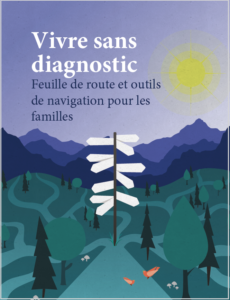
Living without diagnosis. Roadmap and navigation tools for families
And listen to this talk by psychologist Annie Perreault.

Coping with the challenges of diagnostic error and rare diseases
Resources for the undiagnosed
Diagnostic tools
- A tool to try to find your diagnosis: RareLook
- Tools for your doctors: see our page For professionals
Associations and support groups
- RQMO’s Rare community Without a Diagnosis
- Syndromes Without a Name (SWAN) UK
- Patients and families of the Undiagnosed Network(United States)
- Discussion forum on diseases without diagnosis of the organization “Maladies Rares Info Services” (France)
- RareConnect Forum on undiagnosed diseases
Publications and media
- Helping without knowing the diagnosis (Support for caregivers)
- Maux mystères (Mystery Ailments) TV series (Canal Vie).
- Watch the episodes.
- Mystery Diagnosis TV series
- Book: The Genome Odyssey: Medical Mysteries and the Quest to Solve Them

Listen to Caroline’s story about her son, Tommy, without a diagnosis for 14 years!
Genetics and heredity
Eighty percent (80%) of rare diseases are of genetic origin. If you want information about the genetics and heredity of your disease, contact us. A genetic counselor or someone trained in medical genetics can give you basic genetic counseling about your disease or can answer your questions about genetic testing, possible risks to other members of your family, your options for reproduction, etc.
If necessary, we can refer you to a genetics service or clinic/laboratory to carry out a genetic test.
You are not sure that you understood the result of a genetic test or has it been a long time since you received the information? Contact us and we will revisit this information with you.
Caution: If you suspect that you have a genetic disease and want genetic testing, be cautious about genetic tests offered on the Internet (direct-to-consumer offers that do not require a doctor’s prescription). Most of these are not done in certified laboratories and are not good for making official medical diagnoses. The results of this type of test will not be taken into account in the public health system or will have to be confirmed by a certified laboratory.
If you are willing to pay for genetic testing, contact usfor advice. We will direct you to the right services.
Matching Service
Would you like to find an individual or family living with the same rare disease as you or your child to share your experiences or exchange advice?
We may already have someone with your disease in our contact registry of people affected in Quebec (or elsewhere in Canada).Please fill out the form below and we will consult our registry. If we don’t have anyone, we will search for you through other sources.
Please note that we keep your information confidential andwe never give out your name or email address without your permission.
If we can match you with another person, we will ask for your permission each time it arises.
If you want to unsubscribe from the matching registry, write to us by email to notify us.
Reference to resources
Depending on your specific needs, we will find the right resources for you:
- Services in the health system
- Information on government programs and services
- Community resources near you (help for people with disabilities, support groups, respite care, babysitting, financial assistance, etc.)
You can also consult our various directories in the Services section of this website.