
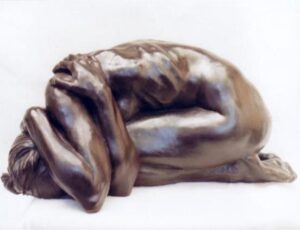
Imprisoned in my own home
You are the victim of a road accident, a workplace accident or a crime: you will receive compensation and services. You are over 65: you are entitled to home care services. If your illness is known and recognized as incapacitating, you will receive a disability pension. But if you’re between 18 and 65 and suffer from a little-known rare disease, you’ll get next to nothing. Yet it’s like being the victim of an accident, but an accident of nature. It’s not your fault. There are thousands of rare diseases. Any one of them can strike at any age. Here’s the story of mine.
Day after day, I have to face the reality of being imprisoned in my own home for having the misfortune to be ill. I suffer from algodystrophy, also known as “complex regional pain syndrome”. It’s a little-known disease, because it’s so rare. It began in my left leg and has now spread to my other leg, affecting my ability to walk. The main symptoms are very acute, even unbearable, attacks of pain, as well as circulatory problems that force me to stay in bed for several days at a time. I’ve been off work for a year. Yet I’m more exhausted now than when I had to stop working. I endure crisis after crisis, my body weakens and I no longer have any quality of life.
For a year and a half, I’ve been fighting to get treatment. I’m still waiting for effective treatment. How many steps I’ve taken to obtain the medical care and social services I thought I was entitled to! Recently, I made a request to the CLSC for help at home. I’ve just been awarded the jackpot: a hefty four hours every two weeks for housework, shopping and preparing my move!
My social life is reduced to social networking on the Internet. People end up drifting away, because I always have to cancel planned activities. “I’m in too much pain, I’ve been writhing in bed all night”: these are words they’ve heard many times. I have to give up my greatest passions, which are dancing, skiing and travelling.
I’m starting my second year of sick leave at 55% of my salary. This means I have to give up my current home. And I can’t help my son with his university studies. I worked 25 years for the government in special education and I still have the fire in me, but I find it hard to believe the words the doctor wrote in my file: “permanent disability”. And despite my doctor’s assessment, I’m not even sure I’ll get a disability pension from the Régie des rentes du Québec when my salary insurance runs out next year.
I’ve followed the TV series “Unit 9” and if it’s representative of the prison environment for women, I’ve found that they have a better quality of life than I do. They have a psychologist, an infirmary, the right social worker priest, music lessons, social activities and even a job to fulfill themselves. I’m a prisoner in my own home, but without services.
Linda Vaillancourt
Special education professional
Rivière-du-Loup