
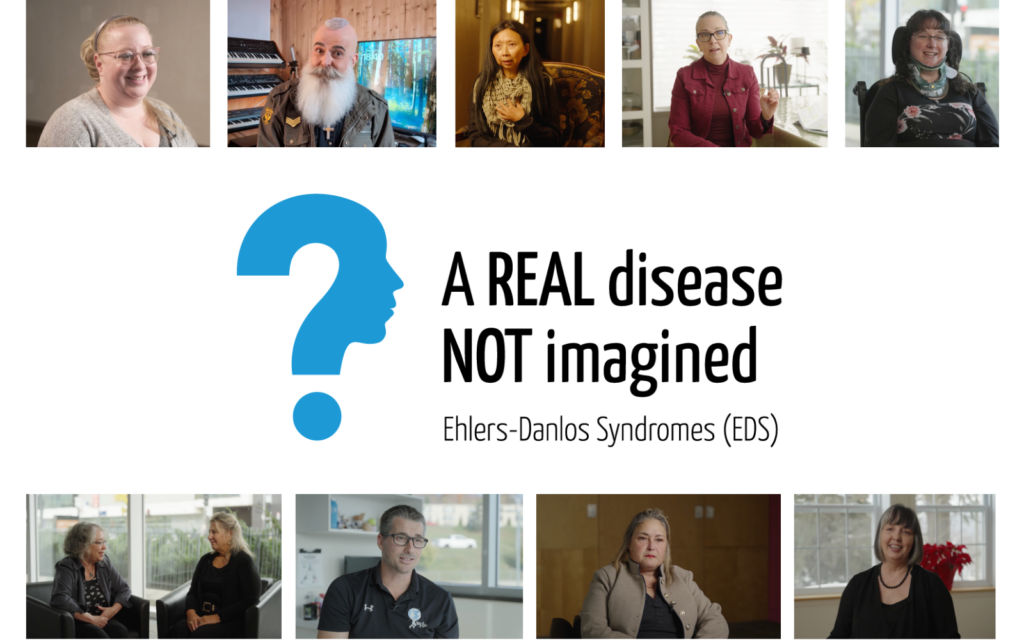
IMAGINE spending years, or even your entire life, trying to figure out what is wrong with you while being told “it’s all in your head”. The Ehlers-Danlos Syndromes (EDS), are complex connective tissue disorders that are frequently misunderstood and stigmatized within the healthcare system.
This Canadian documentary explores the difficult reality of living with EDS, focusing on the common experience where patients spend years searching for an accurate diagnosis and adequate care. Through testimonials from patients and healthcare professionals, this project seeks to shift medical attitudes to ensure those affected receive the same quality of services as any other patient. EDS is not an imaginary disease!
You could not join us at our premiere on May 28?
You can now view the film on YouTube :
Breaking the bias: challenging medical prejudices
Our documentary addresses critical biases that frequently hinder patient care:
- The “invisible” barrier: EDS does not always show on the outside. It can be very different from person to person in its presentation, but it causes many illnesses and suffering.
- The gender gap: Because women are often more severely affected, as for other female diseases, their symptoms are frequently dismissed and said to be psychological. Not being believed causes distress and trauma which in turn increases pain.
- The “trendy” trap: Increased awareness globally has led some to dismiss EDS as a “fashionable” or “catch-all” diagnosis, when in reality, more people are simply gaining access to reliable information and recognizing their symptoms.
The path forward: proposed solutions
Our documentary also highlights several ways to improve recognition for better diagnosis and care for EDS in the medical community:
- Improving medical training to better recognize joint hypermobility and the systemic manifestations that can prompt consideration of all types of EDS.
- Establishing multidisciplinary clinics and integrating EDS care into physical rehabilitation centres.
- Encouraging doctors to actively listen to and consult with affected individuals and their families.
This Canadian documentary was produced by the Regroupement québécois des maladies orphelines (RQMO)/Quebec Coalition of Orphan Diseases in collaboration with the EDS Canada Foundation. It was directed by Gail Ouellette, PhD., genetic counsellor, and expert on EDS.
————————–
Want to help us build a better future for the EDS community?
Regroupement québécois des maladies orphelines (RQMO) /Quebec Coalition of Orphan Diseases
- JOIN OUR MAILING LIST (Bilingual)
- DONATE THROUGH RQMO
EDS Canada Foundation