
Ehlers-Danlos syndromes and hypermobility
Why a page on Ehlers-Danlos syndromes and hypermobility?
The RQMO deals with all rare diseases. However, since the inception of our iRARE Centre, the disease for which we have been contacted the most is Ehlers-Danlos syndrome (or a related hereditary connective tissue disorder). Joint hypermobility disorders and one type of Ehlers-Danlos syndrome (hypermobile type EDS) are now recognized to be more common in the population than previously believed.
Ehlers-Danlos syndrome (EDS) is not well known, underdiagnosed or misdiagnosed. It therefore often happens that affected people self-diagnose via the web or by obtaining information from other people or patient associations. Or, a doctor or other health care professional suspects Ehlers-Danlos syndrome (or another connective tissue disease), but the diagnosis is not confirmed.
YOU ARE SEEKING A DIAGNOSIS OF POSSIBLE EHLERS-DANLOS SYNDROME (SED)
If you think you have SED:
- Consult the following document to find a service to which your doctor can refer you:“Diagnosis and management: resources in Quebec“.
- The most common type of EDS is the hypermobile type (hEDS). Check the diagnostic criteria with this questionnaire. You can also forward this questionnaire to your doctor.
- To assess your hypermobility: the Beighton score.
- If you don’t have a doctor, if you’re having trouble getting a referral for diagnosis or finding medical resources to treat you, contact us.please contact us.
- If you have any questions about genetic testing for SED, see below.
To connect with other people in Quebec: private Facebook page.
If you reside outside of Quebec, contact the EDS Canada Foundation.
These documents can guide you and your doctors:
- Diagnosis and management of EDS: resources in Quebec
- Being the most frequent of the 13 types of EDS, we indicate here the diagnostic criteria for hypermobile EDS. diagnostic criteria for hypermobile EDS (hEDS)
- Joint hypermobility (CHEO document, Ottawa; definition and advice)
- Hypermobility assessment (Beighton score)
- Criteria for EDS vascular type (which can have serious consequences)
- If your symptoms are not consistent with hEDS or another type of EDS, you may have “hypermobility spectrum disorder” (HMSD). See these documents on HSD:
- Ehlers-Danlos Society (English)
- In French (from the UNSED association)
Genetic tests for EDS: usually, the medical geneticists are the ones who will judge if genetic testing should be done for suspected EDS or other hereditary connective tissue disorders. Note that there is no genetic test yet for the most common type, hypermobile type EDS. If you are considering paying out-of-pocket for genetic testing for EDS, contact us. A genetic counselor can guide you on this. Laboratories that advertise on the Internet and do not require a doctor’s prescription are not true genetic diagnostic laboratories. Contact us so that our genetic counsellor can guide you and help you pay less than in a private clinic.
Joint hypermobility: what is it and is it serious?
Watch this video
- To exchange with other people in Quebec: private Facebook page. Email: constellation.info@gmail.com.
Documents and resources
- Joint hypermobility (CHEO document, Ottawa; definition and advice)
- Hypermobility assessment (Beighton score)
- Articles from the International EDS Consortium (new 2017 criteria):
- Presentations by three doctors from GERSED (Groupe d’étude et de recherche sur le syndrome d’Ehlers-Danlos) invited by the RQMO to Quebec in 2022:
- GERSED “SEDenligne” training videos
- EDS Society (international association): numerous documents and recorded conferences
- EDS Society lectures (translated into French) presented by experts on a variety of EDS-related topics
- SED’in France (Patients’ association)
- Recorded lectures from theEDS Canada Foundation (Canada)
- EDS Awareness webinars
- Free electronic book (ebook) to download: Ehlers-Danlos Syndrome: A Multidisciplinary Approach
- Movement therapy to help with your hypermobility (Jeannie Di Bon)
- Disjointed. Diagnosis and Management of Hypermobile Ehlers-Danlos Syndrome and Hypermobility Spectrum Disorders , book, by various EDS experts.
- Transforming Ehlers-Danlos Syndrome. A Global Vision of the Disease,book, Dr Stéphane Daens
- Ehlers-Danlos, La maladie oubliée par la médecine, book, Professor Claude Hamonet
- RQMO webinars on Ehlers-Danlos syndromes (2020):
For doctors and healthcare professionals: follow the EDS Society’s “ECHO” training courses to learn more about EDS and better help your patients.
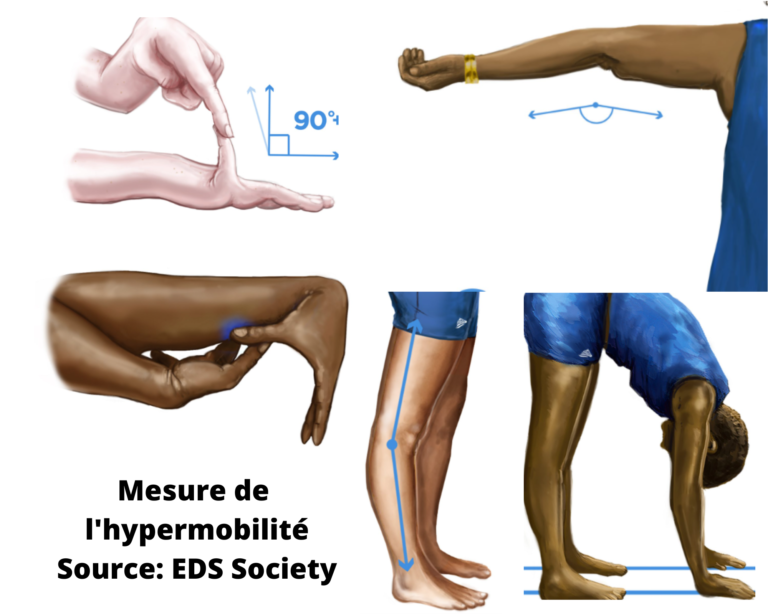
Joint hypermobility means that a person’s joints have a greater range of motion than expected or normal. It can cause subluxations or dislocations of various joints, as well as chronic pain.
For the diagnosis of EDS, this hypermobility is measured by the “Beighton score”. Note to health professionals, you need to know how to measure it and you need to take into account the age and sex of the individual and ask them about hypermobility in their past (e.g. childhood or young adulthood). See 2017 criteria and how to measure Beighton score. Many clinicians also check other joints than those suggested by the Beighton score. Check out:
Ehlers-Danlos syndrome genetic and molecular research project
The hEDS*omics program is a large-scale multicenter research initiative in Quebec focusing on hypermobile Ehlers-Danlos syndrome (hEDS) and hypermobility spectrum disorders (HDS).
The program’s mission is to transform the understanding and management of SEDh and DSH by integrating molecular data with clinical, lifestyle and environmental information.
This project is based at the McGill Genome Centre of McGill University’s Department of Human Genetics. RQMO is collaborating on this research project.
For the time being, patients are being recruited through physicians at university centers (MUHC, CHUM, CHU Ste-Justine and CHUL).
For more information: https://www.mcgill.ca/hypermobile-eds-omics-research/
EDS Research
- Ongoing studies and clinical trials: ClinicalTrials.gov
- Consult Orphanetfor research projects and clinical trials on EDS.
- Projects funded by GERSED (2023)
- EDS Society – Research
- Global Registry (patient registry) of the International Consortium on EDS
- Scientific articles published on the SED
- Research projects initiated by the RQMO:
- Survey on theneeds and priorities of people affected by EDS and parents of affected children (in collaboration with EDS Canada Foundation).
- Resarch done in Quebec to identify the genetic causes of EDS hypermobile type. In collaboration with researchers at Université de Montréal and clinicians from the CHUM and MUHC. Funded by the Fondation Pierre Lavoie. Conclusion: no significant variants found.
Our steps for the recognition of EDS in Quebec
The RQMO has made several representations to various Ministers of Health to plead for recognition of the particular difficulties experienced by people with EDS and their families (lack of diagnosis and care). We have also provided statistics which demonstrate that hypermobile type EDS and hypermobility spectrum disorders are more common than estimated and therefore warrant special attention.
A petition concerning EDS was published on the website of the Quebec National Assembly. The filing of this petition by the MNA, Mr André Fortin, was made on May 23, 2023.
Watch the video (Facebook)
Response to the petition from the Minister of Health and Social Services, Mr. Christian Dubé.